






















Plant of the Week: Monstera adansonii — The Swiss Cheese Vine That's Even Easier Than the Original
Posted on April 17 2026
In this article

---
Welcome to Plant of the Week. Each week we spotlight one plant from our collection and tell you everything you need to know to grow it well.
This week: Monstera adansonii — the Swiss cheese vine. Smaller, more manageable, and arguably more charming than its famous cousin Monstera deliciosa — and every bit as easy to grow.
---
Why Monstera adansonii Deserves Its Own Spotlight
Most people know the Monstera deliciosa — the iconic split-leaf philodendron that became one of the most photographed houseplants of the decade. Monstera adansonii is its smaller, faster-growing, more vining relative — and in many ways it's the more versatile of the two.
Where deliciosa grows upright and wide, adansonii trails beautifully from a hanging basket or climbs eagerly up a moss pole. Its leaves are smaller (typically 3–6 inches), covered in oval holes (fenestrations) that give the plant its Swiss cheese vine nickname — and those holes appear even on young plants without needing to wait years for the plant to mature, unlike deliciosa.
The result: a plant that looks fully developed and interesting from the moment you bring it home.
Singapore advantage: In our warm tropical climate, Monstera adansonii grows noticeably faster than in temperate environments — producing new leaves throughout the year without the slow-down of winter dormancy. Singapore HDB flats and condos with decent natural light are ideal growing environments for this plant.
---
The Fenestration Question: Why the Holes?

The holes in Monstera leaves evolved as an adaptation to wind and rain in tropical forest environments — by having gaps in the leaves rather than solid surfaces, the leaves are less likely to tear in heavy rainfall and offer less wind resistance. There's also a theory that holes allow dappled light to pass through upper leaves to lower ones.
Whatever the evolutionary reason, the fenestrations are what make Monsteras visually distinctive — and in adansonii, they develop reliably even in typical indoor conditions.
---
Growth Habits: Trailing vs. Climbing
Monstera adansonii has two natural forms:
Trailing/Hanging form: Allowed to drape from a shelf or hanging basket, adansonii produces long vines with increasingly larger leaves as they trail. The vines can reach 3–5 feet or longer indoors. This is the most common display approach and works beautifully in Singapore condos with high shelves or ceiling-hung planters.
Climbing form: Provided with a moss pole or trellis, adansonii climbs and produces larger leaves than the trailing form — the same phenomenon seen in deliciosa, where vertical climbing triggers leaf enlargement. If you want the most dramatic leaves, give it something to climb.
---
Monstera adansonii Care
Light
Ideal: Bright indirect light, 4–6 hours
Minimum: Medium indirect light (will grow but more slowly)
Avoid: Direct harsh sun (bleaches and scorches the leaves)
This plant grows noticeably faster in brighter indirect light. Near an east or west-facing window is ideal. In Singapore, even a north-facing window with strong reflected light can sustain healthy growth. It tolerates medium-light conditions better than many Monsteras, making it practical for a wider range of HDB flat and condo positions.
Water
Frequency: Every 1–2 weeks; when the top 1–2 inches of soil are dry
Standard tropical plant watering: water thoroughly, let drain, wait for the top inch or two to dry before watering again. Adansonii forgives a missed watering or two without visible stress.
Singapore note: In warm weather, soil may dry faster than expected — especially in terracotta pots near windows. Check moisture before watering rather than following a fixed schedule.
Yellow leaves almost always indicate overwatering. Drooping leaves indicate underwatering.
Humidity
Ideal: 50–70%
Adansonii appreciates humidity more than some of its relatives. Singapore's naturally high humidity (70–90%) is excellent for this plant. Leaf edge browning from dry air is rarely an issue in Singapore's ambient conditions — the only exception is heavily air-conditioned rooms with continuous cooling.
Soil
Well-draining aroid mix: potting mix + perlite + orchid bark in roughly equal parts. The chunky mix allows airflow around the roots and prevents waterlogging — important in Singapore's warm temperatures where wet soil can lead to root rot faster than in cooler climates.
Temperature
Ideal: 65–85°F (18–29°C)
Singapore conditions: Our year-round temperatures of 25–34°C are within the plant's preferred range. No cold drafts, no winter care adjustments needed — adansonii grows continuously through the year in Singapore.
Fertilizing
Monthly during the growing period with a balanced liquid fertilizer at half strength. In Singapore's year-round tropical climate, you can fertilize consistently throughout the year — there is no dormant season where you'd need to stop.
---
Propagating Monstera adansonii
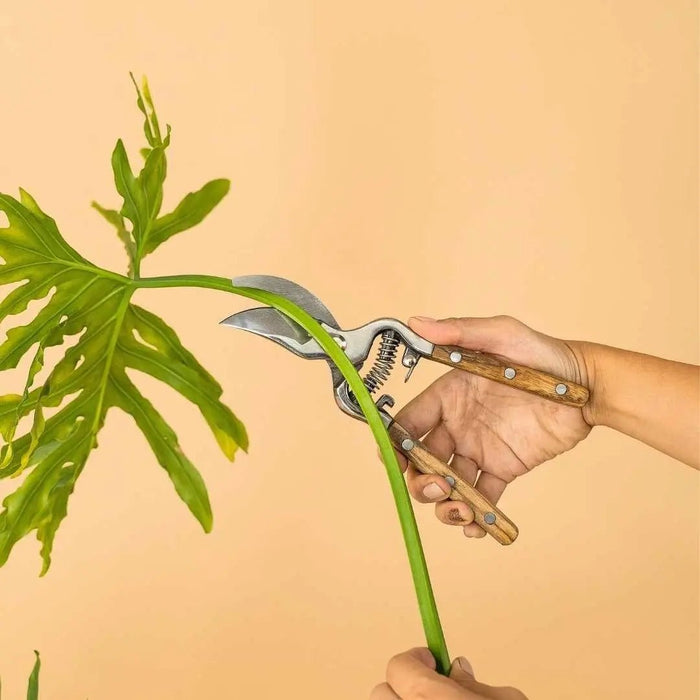
One of the most propagation-friendly Monsteras. Stem cuttings root readily in water:
- Cut a stem section with 1–2 nodes and at least one leaf
- Remove the lowest leaf to expose the node
- Place in water with the node submerged, leaf above the waterline
- Roots form in 2–4 weeks
- Pot up once roots reach 1–2 inches
The fast rooting makes adansonii excellent for propagation sharing — a single mature plant can produce multiple cuttings per growing season. In Singapore's warm conditions, rooting is often faster than the 2–4 week estimate.
---
Common Problems

Yellow leaves: Overwatering — the most common issue. Let soil dry more fully between waterings.
Brown leaf edges: Low humidity (usually from continuous air conditioning) or inconsistent watering. Increase humidity or move slightly away from AC vents.
Small leaves with wide spacing on the vine (leggy): Insufficient light. Move to brighter indirect light.
No fenestrations on new leaves: Normal for very young or very small plants. As the plant matures and leaf size increases, holes develop. More light accelerates this.
Root rot: Overwatering combined with poor drainage. Trim rotted roots, repot in fresh chunky mix, reduce watering frequency. In Singapore's warmth, this can develop faster than in cooler climates — well-draining soil is essential.
---
Adansonii vs. Deliciosa: Which to Choose?
| Feature | M. adansonii | M. deliciosa |
|---------|-------------|--------------|
| Growth habit | Trailing/climbing vine | Upright, wide-spreading |
| Leaf size | 3–6" | 12–36" (mature) |
| Space required | Small-medium | Large |
| Fenestrations | Appears early | Requires maturity |
| Speed | Fast | Moderate |
| Best for Singapore | HDB flats, shelves, hanging baskets, balcony railings | Spacious condos, statement corners |
For most Singapore apartments and HDB flats, adansonii is the practical, beautiful choice. For a condo with high ceilings and floor space to fill, deliciosa is worth the wait.
---
This week we have Monstera adansonii available in trailing 4" and 6" pots, and a limited selection of climbing plants on small moss poles. Browse this week's selection at tumbleweedplants.com/collections/monstera — stock is limited as always for our Plant of the Week feature. Delivered islandwide across Singapore.
---
Quick summary
Key Takeaways
- Why Monstera adansonii Deserves Its Own Spotlight
- The Fenestration Question: Why the Holes?
- Growth Habits: Trailing vs. Climbing
- Monstera adansonii Care
- Propagating Monstera adansonii
- Common Problems
Ready to bring some green into your home?
Browse 250+ hand-picked plants, curated for Singapore homes — delivered to your door.
Browse All Plants →